
Water and wastewater treatment can become an afterthought in a busy manufacturing facility.
Production demands attention. Customer orders must ship. Staffing, quality, maintenance, and supply-chain issues compete for management time. As long as the treatment system appears to be working, it may receive limited scrutiny.
The chemical invoices arrive. The service provider visits. Operators make adjustments. Equipment gets repaired when necessary.
But who is connecting treatment results, chemical consumption, equipment condition, provider charges, and total operating cost?
And who is representing the owner’s interests when those measures drift?
For food manufacturers, water and wastewater treatment deserves the same management discipline applied to other operating expenses. The starting point is understanding what the existing system costs, how it performs, and who is accountable for improving it.
Look Beyond the Chemical Bill
The most visible treatment expense is often the chemical invoice. It is only one part of the picture.
Depending on the operation, the broader cost can include provider service charges, discharge surcharges, solids handling and disposal, maintenance, repairs, and operator time. Recurring treatment problems can create additional demands on people and equipment.
Reviewing these expenses separately can obscure the relationships among them.
A lower chemical price, for example, does not establish that total treatment cost has improved. A change in chemical usage needs to be evaluated alongside treatment results, operating conditions, and downstream consequences.
The useful question is not simply, “What are we paying for chemicals?”
It is, “What does it cost to achieve the treatment performance our operation requires?”
That question creates a more complete basis for managing the system.
A Running System Still Needs Management
A system that continues operating may still have opportunities for improvement.
Recurring adjustments, inconsistent separation, equipment workarounds, and repeated maintenance issues can gradually become accepted practice. Operators may become skilled at keeping the system functioning without having the time, information, or authority to resolve the underlying problems.
Management should understand those recurring demands.
Are treatment results consistent with the conditions entering the system? How does chemical consumption change with production volume or product mix? Are service visits addressing persistent problems? Are maintenance needs being resolved or repeatedly deferred?
Answering these questions requires more than a quick equipment inspection or a review of one month’s invoices. It requires looking at performance, cost, and operating practices together—and listening to the people who work with the system every day.
Three Questions Every Owner Should Be Able to Answer
What is the system actually costing us?
Establish a baseline using available invoices, contracts, treatment records, discharge results, maintenance history, and operating information.
The baseline should distinguish recurring expenses from unusual events and identify gaps in the information. Comparisons should account for relevant changes in production volume, wastewater characteristics, and operating requirements.
A change in spending is a reason to investigate. It is not, by itself, proof of better or worse performance.
Are we receiving the performance and service we are paying for?
Provider reviews should connect charges and service commitments with documented results.
What does the contract include? What service was delivered? What recommendations were made? Were agreed actions completed? Did they improve performance?
This should be a constructive discussion. Capable providers benefit from clear expectations, reliable information, and timely decisions from plant leadership.
The owner benefits from understanding whether the service arrangement is meeting the operation’s needs.
Who owns the corrective actions?
Identifying a problem does not resolve it.
Each priority needs an accountable owner, an agreed next step, and a way to determine whether the action worked. Issues requiring input from operations, maintenance, the treatment provider, or another supplier need coordination.
Without follow-through, the same problems can return at the next service visit or management review.
What an Independent Owner’s Representative Contributes
Plant leadership does not need to become expert in every treatment process or equipment application. It does need access to someone who can examine the technical and financial information on its behalf.
An independent owner’s representative helps translate that information into practical management decisions.
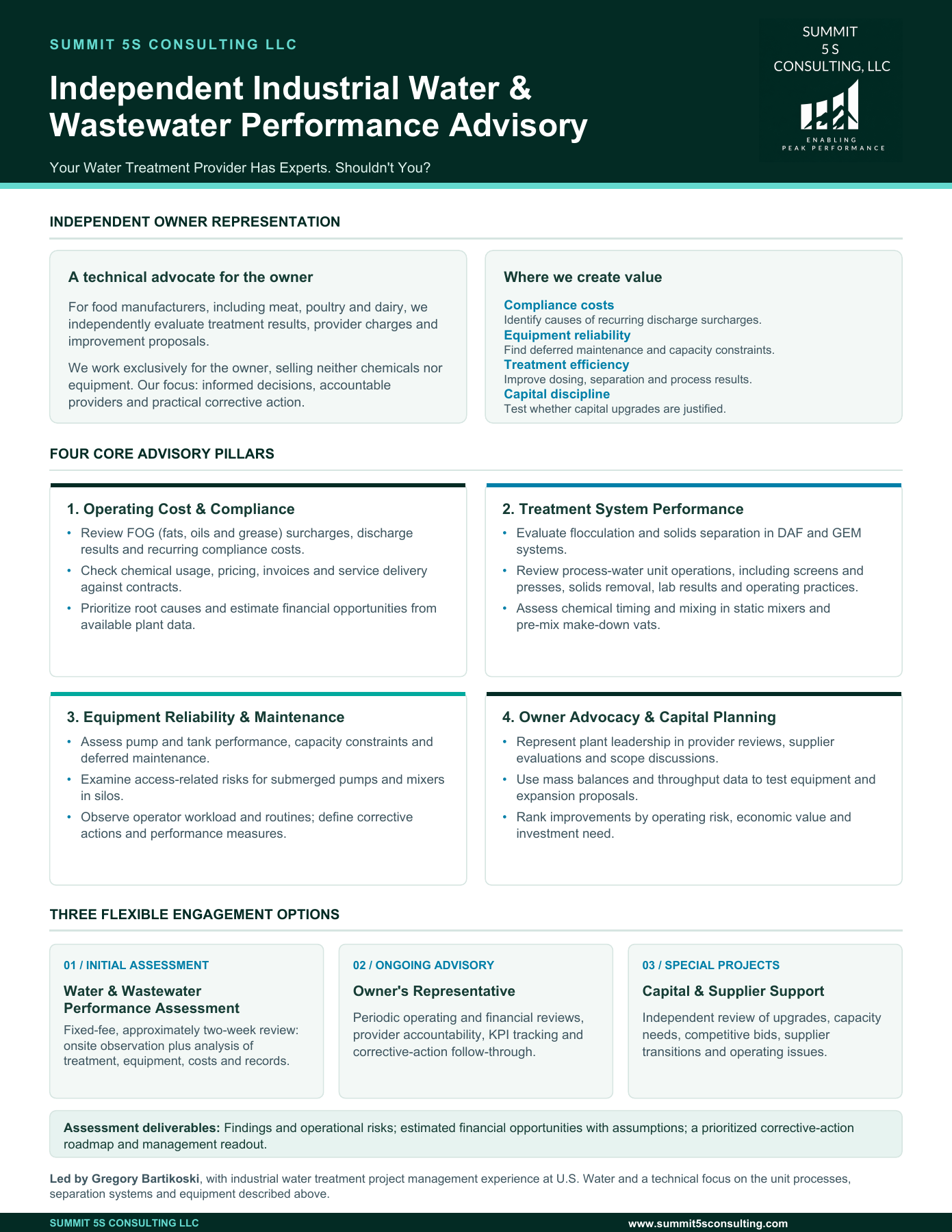
The role can include reviewing treatment results and costs, examining chemical usage and provider charges, identifying maintenance gaps, coordinating supplier discussions, and tracking corrective actions.
Independence matters. When the advisor sells neither chemicals nor equipment, recommendations can remain focused on the owner’s operating requirements and economic interests.
The owner’s representative helps leadership ask better questions, evaluate the answers, and make informed decisions. Operations, maintenance, and service providers remain essential to carrying out the work.
Understand the Existing System Before Approving More Equipment
Equipment upgrades and additional capacity may be justified. The owner should understand the evidence supporting them.
Is a recurring problem caused by an equipment limitation, operating practice, maintenance condition, chemical application, or a combination of factors? What do available flow, loading, and throughput data indicate? What assumptions underpin the proposal?
An independent review can help distinguish corrective work on the existing system from a justified need for investment.
That review should also consider what an upgrade will require after installation: operating attention, maintenance access, consumables, training, and ongoing support.
The objective is to invest where the evidence supports a durable operational and financial benefit.
Start With a Focused Assessment, Then Establish a Routine
A practical assessment begins with direct observation and the information the plant already has.
For an existing food-manufacturing operation, that can include treatment and discharge records, chemical usage, invoices, service agreements, maintenance history, equipment condition, and operator routines.
The initial outcome should be a clear management picture:
- The most significant performance issues and operating risks.
- Preliminary financial opportunities, with assumptions and information gaps.
- A prioritized corrective-action roadmap.
- Ownership and measures for the next steps.
Summit 5S offers an approximately two-week initial assessment, combining onsite observation with a review of available operating and financial information. Scope, timing, and conclusions depend on the facility and the information available.
An assessment identifies priorities. Ongoing management determines whether those priorities produce results.
Periodic reviews can give leadership visibility into treatment performance, spending, equipment reliability, provider commitments, and corrective-action progress. The measures should be few enough to use consistently and meaningful enough to support decisions.
Any claimed savings should be validated against the baseline and operating conditions. Cost reductions must preserve required treatment performance, compliance obligations, and equipment integrity.
Give an Overlooked Utility an Accountable Owner
Water and wastewater treatment may never be the most visible part of a manufacturing business. It still deserves clear ownership.
The opportunity begins with knowing what the system costs, understanding what drives its performance, and making sure someone follows the issues through.
For leadership, the first question is straightforward:
Who is managing this expense—and what evidence tells us it is being managed well?
About Summit 5S Consulting
Summit 5S Consulting provides independent industrial water and wastewater performance advisory services for food manufacturers, including meat, poultry, and dairy operations.
Led by Gregory Bartikoski, whose background includes industrial water treatment project management at U.S. Water, the service represents the owner’s interests in treatment performance, operating cost, provider accountability, equipment reliability, and investment decisions. Summit 5S sells neither chemicals nor equipment.
To discuss an initial Water and Wastewater Performance Assessment or ongoing owner’s representative support, visit Summit 5S Consulting (https://summit5sconsulting.com).